Digital Waste Transfer Notes – DEFRA Compliant, Ready Before the Deadline
DEFRA’s Digital Waste Tracking mandate goes live for waste sites in October 2026, with waste carriers following in 2027. Scrap4Free’s digital Waste Transfer Note tool replaces paper WTNs with a compliant, auditable digital record – built for skip hire companies, waste carriers, scrap collectors, and tradespeople like electricians, plumbers and roofers who need to be ready now.
Who are you?
Pick the one that fits and we’ll take you to the right place.
How it works
Log the job – what was collected, from where – and the rest happens on your phone.
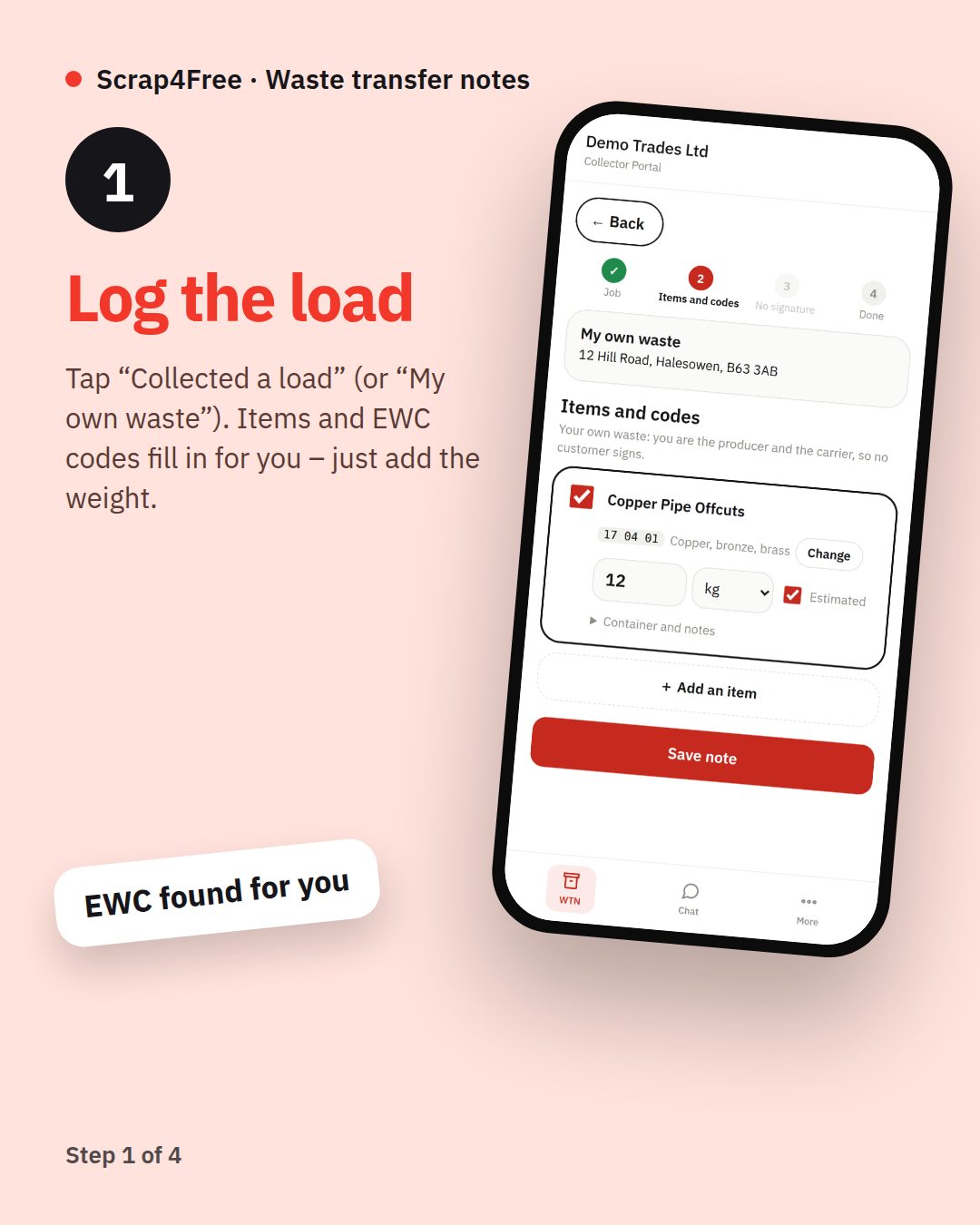
Log the load
Tap “Collected a load” in the app or portal – or “My own waste” for your own trade waste. Items and EWC codes are filled in for you; just add the weight.
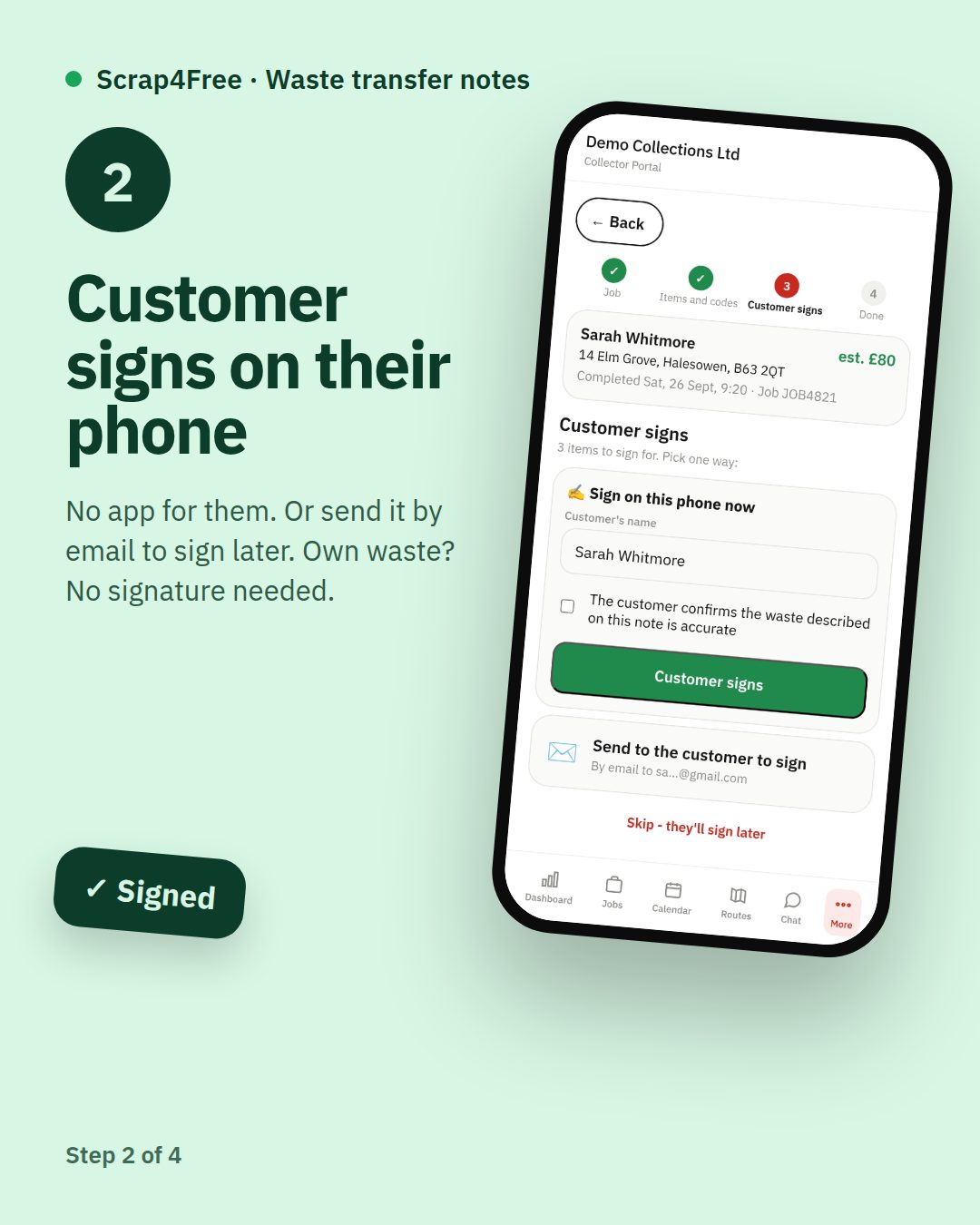
Your customer signs on their own phone
No app needed for them – they sign through a link, or on your phone there and then. Your own waste? No signature needed.
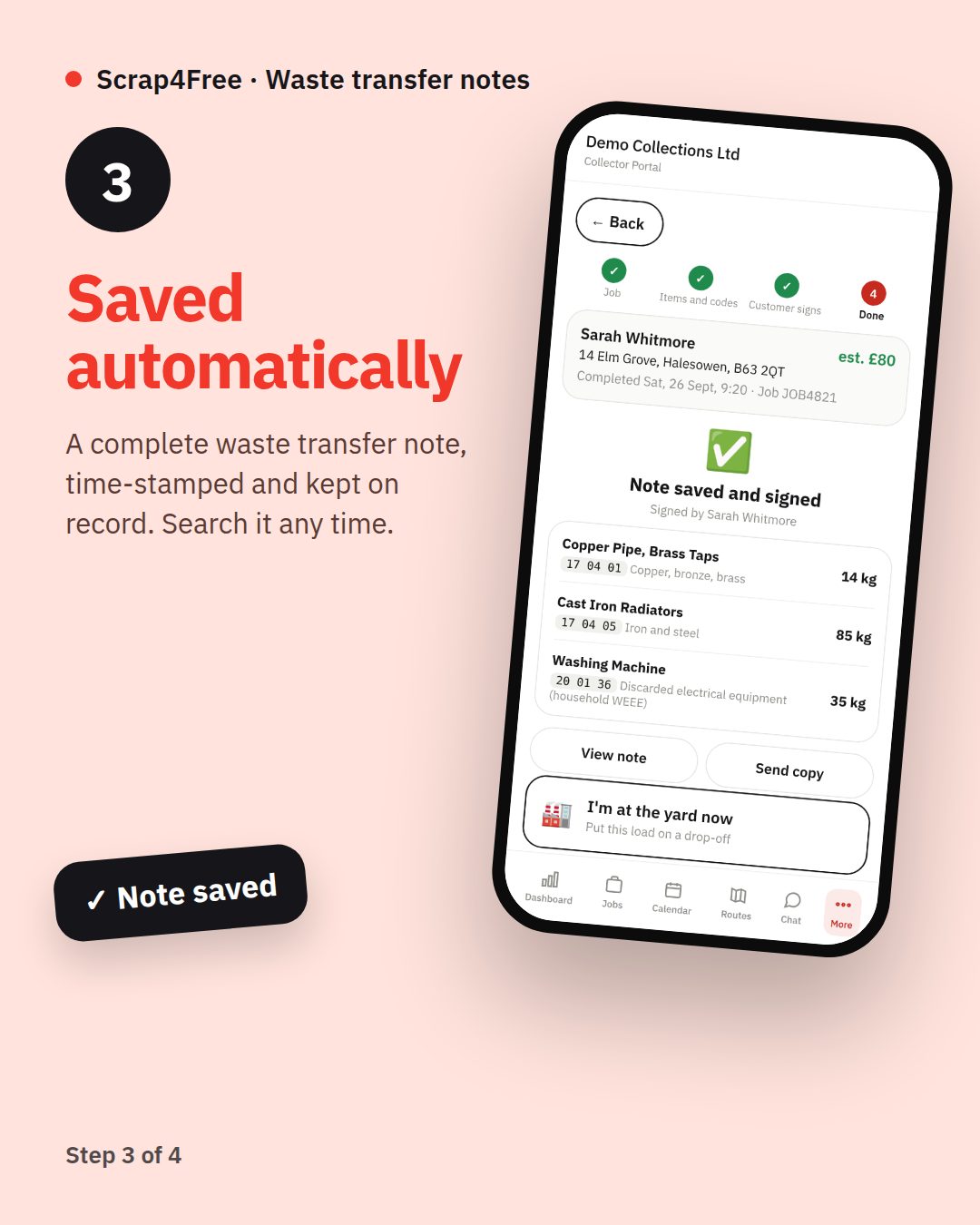
Saved automatically
A fully compliant digital Waste Transfer Note is generated and kept on record – time-stamped and searchable.
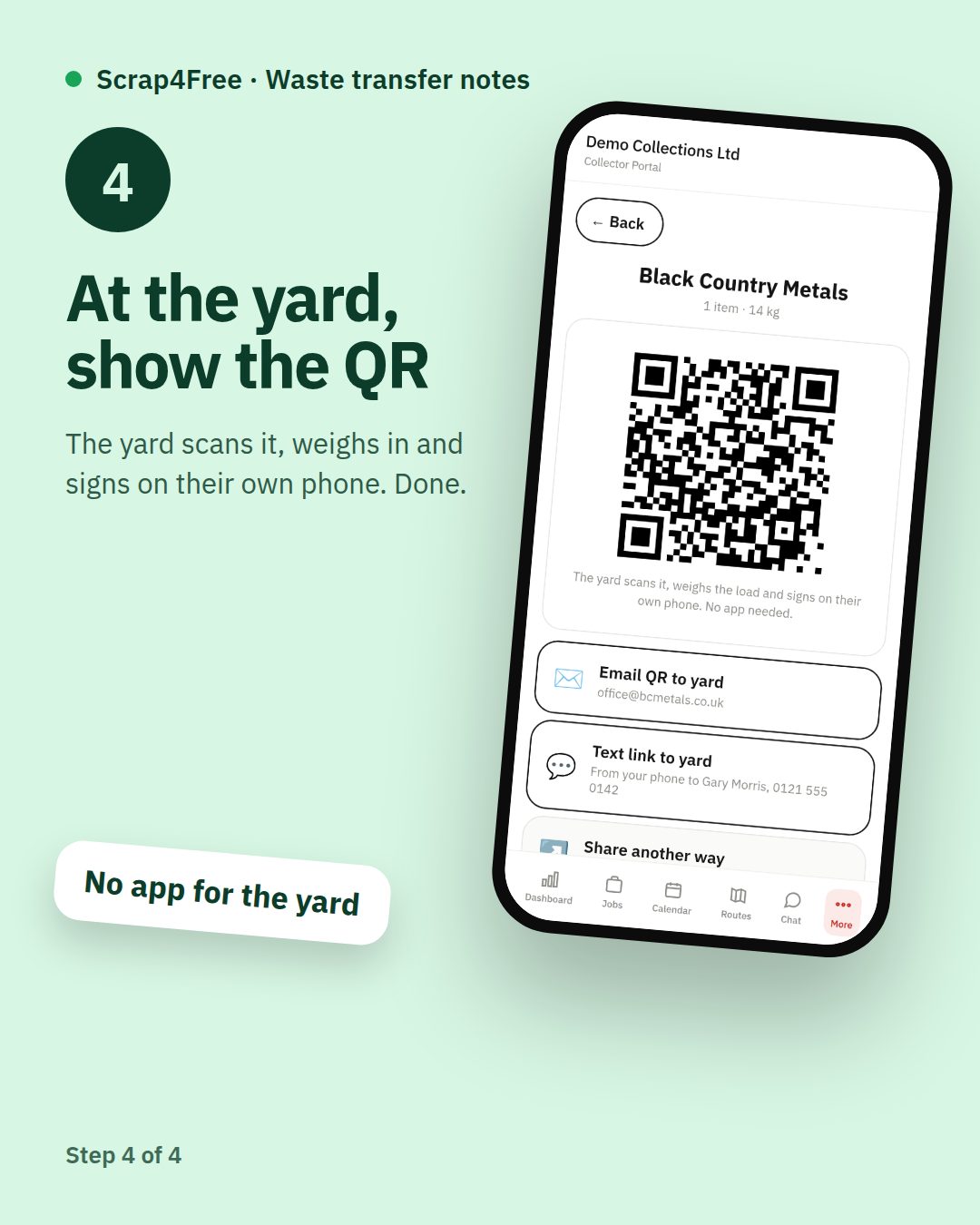
At the yard, show the QR
The yard scans it, weighs in and signs on their own phone. No paper changes hands.
No more paper records, filing cabinets, or scrambling to find a note before an audit.
Waste transfer notes for electricians, plumbers, roofers and builders
Taking your own scrap to the yard? Tap “My own waste”, type what it is and the right EWC code is found for you. You’re the producer and the carrier, so there’s no customer to sign – and every note is saved and searchable.
Electrician
Cable offcuts, old consumer units, light fittings and containment
17 04 11Cables17 04 05Iron and steel17 04 07Mixed metalsPlumber / heating engineer
Old boilers, radiators, copper pipe and cylinders, brass fittings
17 04 01Copper, bronze, brass17 04 05Iron and steel (boilers, radiators)Roofer
Lead flashing, aluminium and zinc gutters, metal sheeting
17 04 03Lead17 04 02Aluminium17 04 04ZincBuilder
Steel lintels and beams, mixed metal from strip-outs
17 04 05Iron and steel17 04 07Mixed metalsKitchen & bathroom fitter
Stainless sinks, old pipework, taps and frames
17 04 05Iron and steel17 04 01Copper, bronze, brass17 04 07Mixed metalsWhy go digital now
Your waste notes, done before you leave the job
Make the note on your phone in a few taps, have it signed, and show a QR at the yard. Free on iPhone and Android – search “Scrap4Free Collector”.
Register your interest
Tell us a bit about your business and we’ll be in touch to talk through how this could work for you.
Run a scrap yard? Use Yard access. Want collection jobs? Join as a collector.
What's my waste code?
Type what you're getting rid of and we'll show you the official European Waste Catalogue (EWC) code for it – the same code your collector logs on your Waste Transfer Note.
Start typing an item above to find its waste code.
Browse all waste codes
Or scroll through the full list below, grouped by category.
Metals
17 04 05
Also called: Radiator, Steel, Iron, Scaffold, Sink
17 04 01
Also called: Copper, Brass, Bronze
17 04 02
Also called: Aluminium, Aluminum, Alloy wheel
17 04 03
Also called: Lead
17 04 04
Also called: Zinc
17 04 06
Also called: Pewter, Tin can, Tin foil
17 04 07
17 04 11
Also called: Cable, Wire, Wiring
17 04 10
20 01 40
15 01 04
WEEE / electricals
20 01 23
Also called: Fridge, Freezer, Air con, Air conditioning, Aircon, Dehumidifier
16 02 11
20 01 35
Also called: Television, Tv, Monitor, Crt
16 02 13
16 02 14
Also called: Computer, Laptop, Printer, Server
20 01 36
Also called: Washing machine, Dishwasher, Tumble dryer, Dryer, Cooker, Oven, Hob, Boiler, Microwave, Toaster, Kettle, Vacuum
16 06 01
Also called: Car battery, Lead acid
20 01 33
20 01 34
Also called: Battery, Batteries
20 01 21
Also called: Fluorescent, Strip light, Lightbulb
Vehicles
16 01 06
Also called: Car, Vehicle, Van
16 01 04
16 01 17
16 01 18
16 01 03
Also called: Tyre, Tyres
16 01 07
Also called: Oil filter
16 01 21
13 02 05
Also called: Engine oil, Motor oil
Construction & demolition
17 01 01
17 01 02
17 01 03
17 01 07
Also called: Brick, Rubble, Concrete, Tile, Ceramic
17 02 01
Also called: Timber
17 02 02
Also called: Window, Glass
17 02 03
Also called: Plastic
17 03 02
Also called: Roofing, Bitumen, Tarmac
17 05 04
Also called: Hardcore, Soil, Stones
17 06 04
Also called: Insulation
17 08 02
Also called: Plasterboard, Gypsum
17 09 04
Packaging
15 01 01
Also called: Cardboard, Paper
15 01 02
15 01 03
Also called: Pallet
15 01 06
Also called: Packaging
15 01 10
Household / bulky
20 03 07
Also called: Mattress, Sofa, Wardrobe, Furniture, Carpet, Bed frame
20 01 38
Also called: Wood
20 01 39
20 01 01
20 01 02
20 01 11
Also called: Clothing, Clothes, Textile
20 03 01
Also called: General waste, Household waste, Rubbish, Junk
20 03 03
Hazardous / special
20 01 27
Also called: Paint, Adhesive, Solvent
20 01 29
20 01 19
Also called: Weed killer, Pesticide
Frequently Asked Questions
What is a digital Waste Transfer Note?
A digital Waste Transfer Note (WTN) is an electronic record of a waste collection – what was collected, from where, by whom, and where it went – replacing the paper WTN. It's signed by the customer on their own phone and stored automatically, so there's always an auditable record.
When does DEFRA's digital waste tracking mandate start?
Waste sites are required to track waste digitally from October 2026. Waste carriers follow in 2027. Scrap4Free's system is built to match DEFRA's data definitions now, so businesses using it are ready ahead of both deadlines.
Do I need an app to use it?
Your customer doesn't – they sign on their own phone through a link, with nothing to download. You can log jobs from the free Scrap4Free Collector app (iPhone and Android) or from your online account, and the Waste Transfer Note is generated and stored automatically.
Is it compliant with DEFRA's requirements?
Yes. The system is built around DEFRA's published data definitions for Waste Transfer Notes, so the same information can be carried across into DEFRA's digital tracking service once the carrier-side API goes live.
Do electricians, plumbers and roofers need a waste transfer note for scrap they take to a yard?
Yes. When you pass waste from your work – cable offcuts, copper pipe, old boilers, lead flashing – to someone else, such as a scrap yard, a waste transfer note should record what it is, its EWC code, how much there is, and who handed it over to whom. Scrap4Free lets you make that note on your phone in a few taps using "My own waste".
Which EWC code do I use for cable, copper pipe or lead?
Common codes are 17 04 11 for cables (that don't contain hazardous substances), 17 04 01 for copper, bronze and brass, 17 04 03 for lead, 17 04 02 for aluminium, 17 04 05 for iron and steel and 17 04 07 for mixed metals. In the app you just type what it is – for example "copper pipe" – and the code is suggested for you. You can also use the EWC code lookup on this page.
Do I need a waste carrier registration to take my own waste to a yard?
In England, a business that carries its own waste usually needs to register as a waste carrier with the Environment Agency – a lower-tier registration is normally enough, but construction and demolition waste needs an upper-tier registration. Check the current rules on GOV.UK for your situation.
How much does it cost?
Register your interest below and we'll talk you through pricing for your type of business – skip hire, waste carrier, scrap collector, or trade.
Waste carrier registration in England: GOV.UK – register as a waste carrier.